Play
On 28th March 1990 Play was born. The first version just loaded a sample at a fixed frequency and played it through the speaker. It had to be hand crafted assembly code since my development machine was only a 10MHz 286. Version 1.0 was born, with only 440 lines of code, and a 1492 byte executable.
Play got a graphical user interface for DOS by April 1990, using libraries all coded in assembler. Later that month I worked on circuits that could do sampling through a A/D connected to the parallel port.
Play was given rave reviews by several UK magazines in 1991-2 and was included on magazine cover disks. In 1991, Play was distributed with the Activision game "Leather Goddesses of Phobos II".
 Play v4.10 (75k) [Note: this program does not work inside Windows]
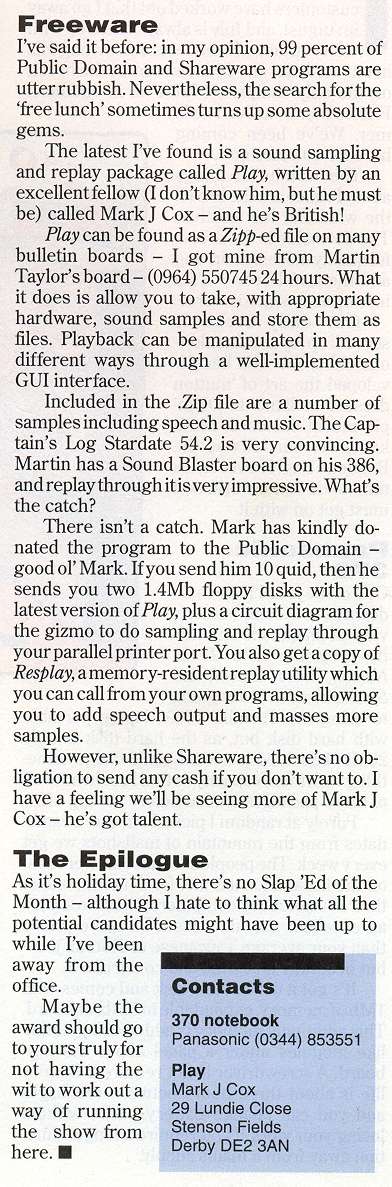
- Computer Shopper Article, November 1991
(JPG, 125k)
99 percent of Public Domain and Shareware programs are utter rubbish. Netherless, the search for the 'free lunch' sometimes turns up some absolute gems .. I have a feeling we'll be seeing more of Mark J Cox - he's got talent
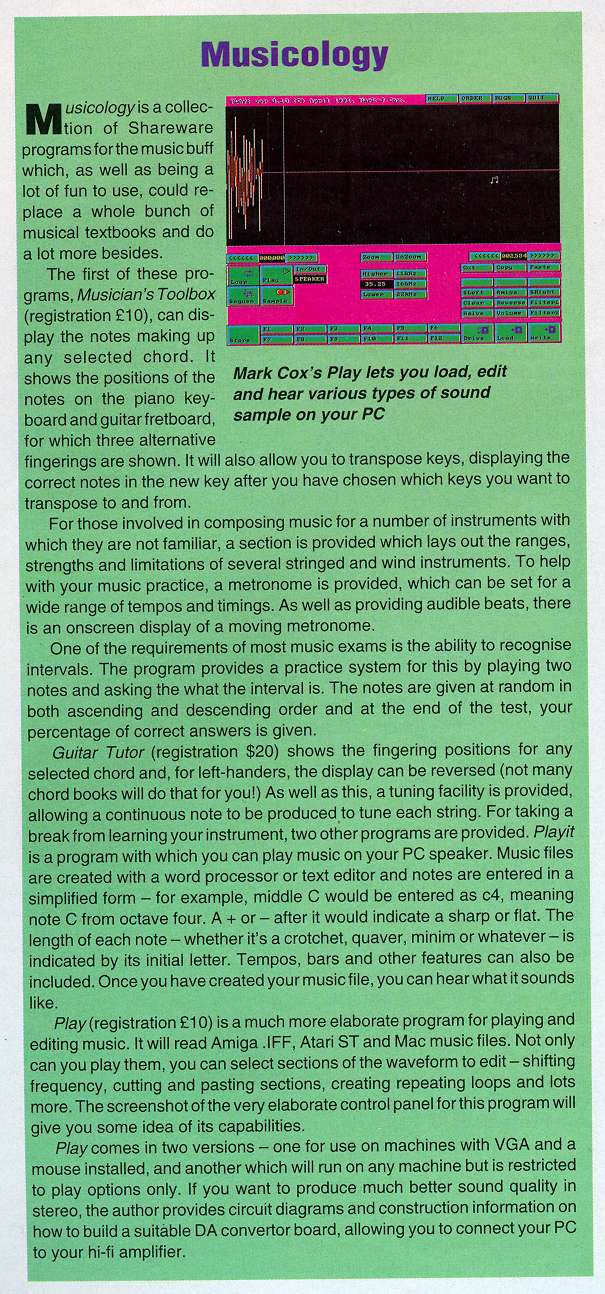
- Computer Shopper Article, April 1992
(JPG, 179k)
Play is a much more elaborate program for playing and editing music, Not only can you play them, you can select sections of the waveform to edit - shifting frequency, cutting and pasting sections, creating repeating loops and lots more
- Infocom's Leather Goddess II brocure
(JPG, 94k)
We have bundled a couple of sound utilities with the game .. courtesy of Mark J. Cox, a computer whiz from England

April 1991 saw the release of version 4.10, the last public version of Play. A friend took over development and added numerous new fetures, but the version was never released (see screenshot below)
|
|
|
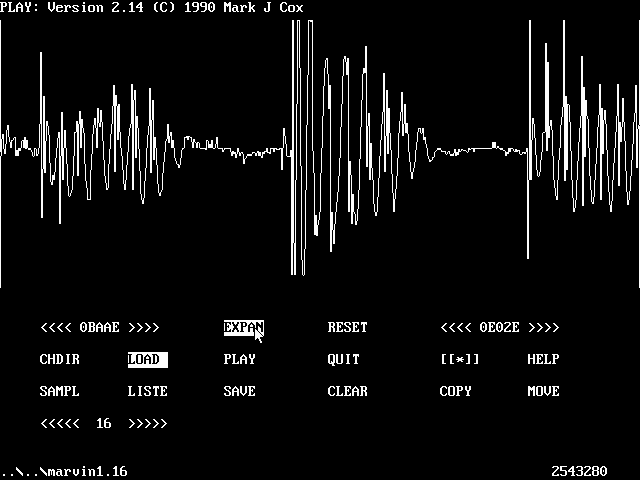
Play 2.14 was the first to have a graphical interface, although
it was pretty basic
|
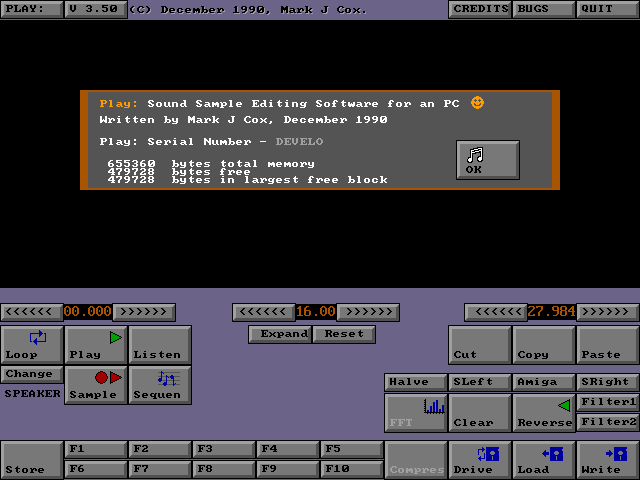
By Play 3.50 the interface design had become stable
|
|

|
|
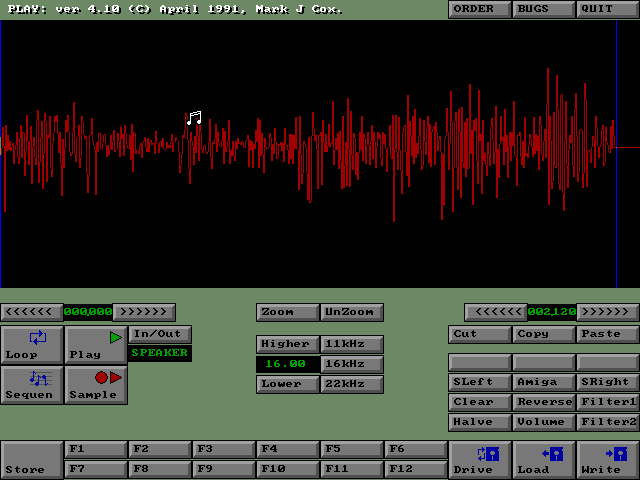
Play 4.10b was the last public version
| Play 4.32 was never released but included multiple input and output support including stereo, new graphical file chooser, and a lot more |
Created: 01 Apr 1991
