31 Dec 2011: Making of the SONIK Gravitation music video
The inspiration for the Sonik video for Gravitation came from a local friend of ours, a talented and world-renowned photographer, Adrian Brannan. Ade is famous for his analogue photo collages (please give him a 'like' on his Facebook page):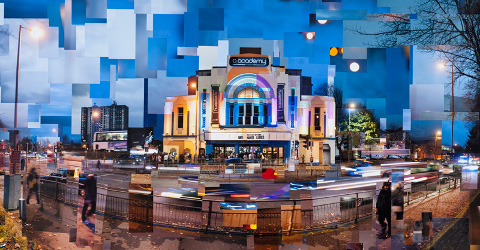
We often wondered how the same effect would look if rendered with video. With video you've got the extra element of time, each segment of the mosaic can be running from a different starting point, with a different speed, and even a different direction. In addition the segments themselves can move over time. Would this end up with an effect that was just too much of a mess? Or would it give an effect that helps visualise the consequence of spacetime?
We started by taking several videos at three different locations over the period of a year with a Kodak Zi8 camera. A motorway bridge over the M74, just outside the Buchanan shopping center in Glasgow, and a bench in Strathclyde park. Lining up the images was done roughly by using lines drawn on acetate stuck over the camera screen.
The software to do the mosaic effect was hand-written. We used a simple scripting language, Perl, and the image library GD. On a relatively modern Linux PC running Fedora 16 we can render near real-time 720p HD even when handling 300 segments of mosaic. A simple language controls which parts of the screen come from which video, and the first half of the music video uses this with simple effects having just a few boxes overlayed:

Later in the video things get more complicated, using randomisation to pick the location and movement of each segment:
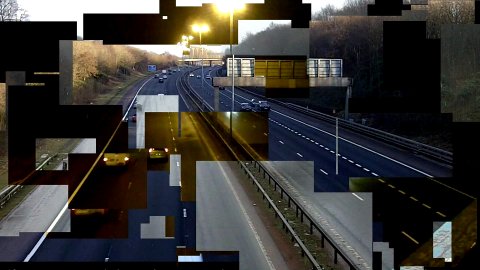
We used our scripts to create a number of ~13 second segments, then put them all together using kdenlive. The intro and outro were taken from a different video from a hotel room in London Victoria; the intro using a 'miniature' effect, and outro using the randomised segments applied to a single video.
The Perl script and a 5 frame example is available to download: 2011-sonik-vid-example.tar.bz2 (1.4M)
Watch the full video, or click through to YouTube to see it in HD:
Created: 31 Dec 2011
Tagged as: fedora, sonik